
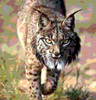

Gender: Female
Age: 29
Race: Iberian lynx shape-shifter
Height: 5'0"
Weight: 105
Physical Description: In human form, Cat is rather short, but it would be a mistake to underestimate her based on her diminutive height. With her compact build and athletic musculature, she can accurately be compared to a rock. Despite her obvious strength, few would think to describe her as masculine. She is saved from that by her lynx heritage, which in addition to giving Cat her small stature, also grants her a certain litheness and grace. Her sleek movement imparts an impression of finely controlled power. Her face is rather square, with a gently sloping chin and large, upward slanting eyes that rather resemble the features of her feline alternate. Her skin is the color of toasted almonds, with undertones of golden honey, and her irises are a brown so light as to appear amber. The short, uneven mop of her hair is only slightly darker, a tawny shade streaked with auburn and tipped in black; it is coarse like fur and perpetually disheveled, falling just short of covering her ears. Long sideburns extend down to her chin.
As a lynx, she stands about two feet (0.6 m) tall at the shoulder, and measures just over two and a half feet long from head to tail. Said tail is much shorter than that of the average feline, rather bob-like and dipped in black at the end. She weighs in at around 25 pounds. Cat is only half the size of the more common Eurasian lynxes, and, unlike that species, her tawny coat is marked with distinct, leopard-like spots. Her tall, pointed ears are likewise tufted in black feathering, as is the ruff of fur extending below her jaw in what could be described as a double pointed goatee. Upon shifting, her eyes brighten to burnished, liquid gold.
In her intermediate form, Cat retains her human face and torso, but gains some of the more practical attributes of her lynx. Large, sensitive ears emerge from her hair, swiveling to best take in threats from the surrounding environment. Her pupils shift to vertical and their color lightens, signifying the transition to the superior sight of the feline. While she doesn't grow a full muzzle, her teeth sharpen into points designed for shearing flesh. Her hands and feet morph into hefty claws, and her legs change only partly, adding strength without altering her joints so much as to disable upright movement.
Possessions: As she has traveled far from the southwest and can carry nothing in Lynx form, Cat has little to her name. When traveling only short distances, she sometimes carries a specially sewn bag, looped over her feline neck, with only a change of ragged clothes in it.
Strengths or Powers: (Present in both forms unless otherwise noted)
Physical strength and agility - A combination of genetic inheritance and a strenuous existence have gifted Cat with strength superior to that even of the average man, far outstripping most of her female counterparts. Moreover, chasing down quick, bounding prey has required her to fine tune her prowess, so that each and every muscle movement is under the strictest control, granting her impressive nimbleness.
Efficient travel (Lynx) - Long, powerful legs featuring oversized paws, equipped for walking on uneven terrain and snow cover, enable her to distance quickly and without tiring, even over the most treacherous footing.
Wilderness survival (Lynx) - A natural and very adept predator, Cat can easily stalk and take down anything from large rodents to small deer. Even rabbits are rarely dexterous enough to escape her. Additionally, her thick pelt protects her from the elements, including bitter cold, harsh sun, and inclement precipitation.
Wilderness lore - Besides the simply ability to survive out in nature, she has a close connection with the earth that allows her to find her way and track efficiently. Long after the footprints vanish, Cat can still determine who has passed through an area, and sometimes even their condition (based on scent signatures). She can also detect incoming weather patterns even earlier than most wildlife. To take full advantage of these abilities, she must be in lynx form, but retains some degree of the skills--primarily tracking--as a human.
Lie detection - Lynxes are regarded by many cultures as seers and keepers of secrets, derived from their keen senses and ability to move through the forest unseen. Using said senses, Cat can nearly always tell when a person is lying, due to the incongruity between their words and their behavior and physical bearing. Although this doesn't necessarily mean she can guess what truth they are hiding, it does protect her from falling prey to tricksters' schemes. Additionally, it gives her a knack for knowing who she can trust, based solely upon how much that person lies to her.
Stealth - Without requiring any magic, she is able to use her extensive knowledge of light and shadows to move around unseen. Much of this ability comes from simple patience, the willingness to wait until no one is looking or all are distracted, but practice has made her adept at moving silently and without attracting notice, as well. She is especially skillful at this while in lynx form, able to evade most except those using supernatural perception, but is also quite good as a human.
Priestess - Among her own people, Cat holds a much-respected position, and she is honored for the self-sacrifice demanded of her. She is confident in her ability to make the right decisions and to serve as spiritual leader of her people. Away from home, this translates into an easy self-assurance, a willingness to accept greater responsibility, and a cool competence in most situations. She is well-spoken and often knows how to say the rights things to motivate people to do what she wants them to do, especially in the realm of religion and other non-rational belief systems. Zealotry can be harnessed and directed, making it a powerful and potentially dangerous force. Note, however, that she tends to do this unconsciously, rather than in purposeful manipulation (such as would be the case in politics, for example).
Weaknesses:
Vulnerability to arid conditions - While extremely hardy under most conditions, Cat is evolved for the humidity of the Mediterranean climate from whence her species came. Thus, although she can usually withstand extreme temperatures, it is much harder to do so in heat, especially if she lacks fresh water. In these circumstances, she is prone to overheating and dehydration.
Small size - Despite her strength, Cat's petiteness can still be a disadvantage. This is especially true when facing an opponent of vastly superior size, such as a trained warrior or guardsman, or a larger shifter predator like a bear or even wolf. Such enemies can wreak havoc on either the lynx or girl, using both their superior might and range.
Inability to lie - Cat considers lying to be a purely human invention, one that never penetrated her close-knit community of lynx shifters. Therefore, while she is excellent at detecting lies, she herself never learned how to tell them, nor does she desire to. She finds the covering up of secrets with untruths to be rather distasteful, and instead, if questioned about something she doesn't wish to reveal, will simply smile knowingly and hold her silence.
Superstitiousness - Having been socialized and indoctrinated into a sectarian culture with little to no outside contact until adulthood, she can sometimes fall prey to dogma. Natural phenomena will almost always be taken as an omen, usually negative; frequently they are viewed as warning of impending danger, not just on an individual level but to great numbers of people. Certain actions or occurances must always be preluded--or, conversely, followed--by the correct ritual, performed according to exact precepts. Other actions, deemed taboo, are entirely proscribed, and individuals who have committed such taboos must be shunned, or, under extreme cases, punished or even killed. Under the right circumstances, this pattern of behavior can border on zealotry. Fortunately, few of her religious edicts apply to those outside of her sect, so it is rare that Cat would take action against them. On the other hand, she continues to judge other people, as well as events, according to the standards of her cult. This tends to make her close-minded towards outside belief systems that vary from her own. This is a natural result of the spiritual devotion that has been instilled in her since a young age.
Outsider status - A newcomer to Thar Shaddin, she has no friends, and little knowledge of the local culture and laws. This can often result in personal confusion and social misunderstandings. Also, while she is proficient in the language, her foreign accent makes her stick out unless she refrains from talking.
History: (The oral tradition as recounted by Catalonia)
"The story of my people is rich with generations, and yet much of our past has been lost, forgotten in the face of a present that demands all our attention.
"The history we teach our youth begins at the Great Poisoning, some 2400 years ago. Prior to what your culture calls the Changers' War, our territory was some of the richest in all of Eyropa, replete with many kinds of forests and the diverse creatures that inhabited them. We call that land Paraiso, and to this day it lives on in my people's memory, more myth than historical fact, much like the Elysium of your culture. Despite the disbelief of some, there is little doubt in my mind that Paraiso once existed; our tales of that place are too vivid, full of details that ring true. Our dying land is scattered with the bones of animals and plants no person living now has ever seen, but which seem to match our legends. There are too many signs for it to be mere coincidence.
"Whether Paraiso was real or not, it is lost now. The Changers' War blighted our territory. It has been a painful, lingering death, but it is nearly complete.
"Among your people, the demi-god Teodinus is regarded as a savior, but to us he is the Murderer of Paraiso. The separation of the continents of Setkhantos and Eyropa, achieved by the brute force of his magic, set off a wave of cataclysmic changes that ultimately doomed our homeland. Tidal surge from the oceans spilled over the great mountain ranges that line our coasts and into the central plateau. The mountains, once revered as mighty protectors of the lush but vulnerable interior, now trapped the salt water, transforming the central plateau into a wasteland of immense, briny lakes.
"Much life was drowned in the original flood. Some areas, however, were saved by their relative elevation, and managed to sustain many native plants and animals. The first great migration began, from those places no longer able to support life to the geographical safeholds that remained. Few of these refuges were large enough to provide adequate food for more than a small group of my people, and so we were forced to split up, with the ancient tribes separating into minor, kin-based clans. This period of our history is known as the Diaspora. Many of our most ancient practices were lost, fading in the memories of each successive generation. The only knowledge needed was that which aided our survival; the only rituals that remained were those that held my people together, that promised us a better future when we might return to what once was.
"The flooding of the interior was only the beginning. As the Changers' War dragged on, the defilement of our homeland deepened. Ash and acid rain fell from the sky, poisoning our last sources of fresh water and contaminating many plants with toxins. Through our prey, which fed on these plants, the bane was spread to my people. Great numbers perished from the ensuing illness.
(Cat, like most of her people, is not aware that this marks the emergence of the lynx shifters from their historically human population. The overwhelming evolutionary pressures selected strongly for those who possessed the ability to shift, until eventually all the full humans died out.)
"Sweltering under the uncharacteristic heat that engulfed our land during the War, many young brine lakes began to evaporate. Some clans rejoiced. But as the waters receded, they left behind a thick crust of salt in which nothing could grow. The Southeast was most affected, and to this day is riddled with such salt pans. In other areas, the brine lakes still remain. Only those which were able to empty naturally into nearby rivers and streams have left the land more or less unscarred.
"Eventually, the toxic showers ceased, and were replaced with clean rain. I can only assume that this corresponds to the time when the Seal was created. Though my people, once numerous as the cork trees, were decimated, we persevered.
"Generations passed. My people began to recover from the Poisoning, as did the land. Not coincidentally, the human settlements were also growing, and spreading outward into our territory at an ever increasing rate. Fishing villages on the coastline expanded into major port cities, which in turn spawned their own surrounding communities, mostly along the seaside and rivers. The humans ate up our land in much their usual pattern. Towns within the interior sprang up along the main trade routes, each needing its own space to support the population. They cut down our forests to provide fields in which to plant their crops and graze their livestock. In response to this habitat loss, numbers of our native prey dwindled--the rabbit and hare, the roe and fallow deer, moutons, all were affected to varying degrees.
"Many of my people began to starve. In desperation, we began to pick off animals belonging to the humans' herds, the occasional sheep or calf when we could find no native prey. It seemed only fair: they took our land so as to feed their livestock, and we extracted a small fee for that land. They didn't see it that way, however. Likely they didn't realize that we were any different from the average, stupid predator. Any contact we had with the humans at that time was purely coincidental, and we have always been secretive about our abilities. Whatever the case, they retaliated by selectively sprinkling their crops and gardens with slow-acting poison, which worked its way up the food chain to my people. Many suffered agonizing deaths before we realized what was happening. Eventually, we were forced to leave the territory in order to escape the taint the humans had introduced.
"Meanwhile, the spread of the humans continued. Besides the normal growth in numbers that species tends to exhibit, they left a trail of deadened land as their populations shifted about. Much of the soil was poor due to the lingering effects of the Poisoning, and could only support farmlands for a scant few years before it was devoid of any remaining nutrients. The humans, of course, simply cut down more forest for new fields without batting an eyelash. The abused earth was unable to sustain enough plant life to hold the soil in place, much less retain water. A slow process of desertification began in many areas.
"In an effort to protect our remaining territory from human encroachment, we began systematically picking off individuals whenever they wandered onto our land, including caravans traveling through. What starts as an isolated trade route will almost inevitably develop into a string of villages and towns, as we well knew. Taking down a human man is dangerous even for a small group of us, but when he stumbles out of camp to relieve himself in the middle of the night, he has little hope of escaping us. We didn't hesitate to hunt down the young, the old, or the sick. Their flesh provided my starving people with much-needed nourishment.
"Despite our predations, our existence remained more of a rumor than established fact, something a mother might use to frighten her children into obediance. Eventually, the first elves arrived from Darleone island. Large numbers of their people were migrating from Galicia, the main port city in the southwest, up through the peninsula and deeper into Eyropa. Many settled along the way, augmenting the human populations. My own people were forced deeper into the interior and westward, towards the realm of salt plains and brine lakes.
"We realized that, in several generations, there would be little to no forest left to shelter us, in which to chase rabbits and raise our young. Espousing this warning, a shaman grew to prominence among my people. Galicia was well respected within her own clan as an accomplished seer. The recipient of divine vision, she spoke often of foreseeing a time when come when we would be forced to leave our land and find a new home, and she founded a religious sisterhood with the purpose of preparing for that moment. I am a member of that sisterhood, one who was sent out to seek the new homeland.
"Galicia never made clear how exactly the finder would know when she found what she sought. Many of my people claim that the right one will just know. That is easy for them to say, as they have not been sent out on a search without being told what they are looking for. The seer did specify, however, that those left in the peninsula would know it was time to leave when the last untouched cork tree is stripped of its bark. When that happens, the sky itself will mourn, and the sun, in its sorrow, will clothe itself in garments of black.
"In the meantime, we keep watch over the cork forests and continue our search. We have little choice now. Not enough of my people remain to reclaim our native territory, or even to resist the persistent tide of humanity. It is uncertain what the future will hold for us, but my people will not let go of their faith. We will be reborn in Ba'al's eye."