

More thoughts on elves - the question of age
The setting states that elves can live for approximately 300 years and to provide context, I've put together this for consideration.
Elves mature at a similar rate to humans until they hit the age of twenty-five. At this time, the body clock slows and aging occurs less rapidly than it does in humans. From ages 25 to approximately 99, an elf maintains the youthful appearance of a young adult. The next 100 years progress from the equivalent human age of 35 to 60 over the course of 100 years. The last 100 years progress from human age equivalent 60 to 100. Elves rarely live past the age of 250 - 275, or roughly 80 to 90 years in human terms, but some on Darleone have been known to live to the venerable age of 300 before passing quietly into the Dreaming.
[RACE] Thoughts on elvish-ness
Re: Thoughts on elvish-ness
A story is like a tapestry; it is never finished until the final thread is sewn.
Profile | Thread Tracking
Profile | Thread Tracking
-
KoriStronghammer
- Citizen
- Posts: 332
- Joined: Wed Jul 28, 2010 7:27 am
- Name: Kori Stronghammer
- Race: HumanNorthernman
Re: Thoughts on elvish-ness
Frug wrote:They're too often idealized a la lord of the rings; sliding down stairs while surfing on a shield and plugging arrows into orks. Basically portrayed as ascendant humans, what we all aspire to be. I don't go for that.
That's actually one of my favorite scenes.
Through the gates of hell, as we make our way to heaven, through enemy lines, Primo Victoria!
Re: [RACE] Thoughts on elvish-ness
Had some interesting ideas about elves pop up in chat that I'd like to see some more discussion on.
1. Do all elves have access to magical abilities, or just a natural affinity to magic for those who do have magic? A bit of both? Is an elf not having a magical ability a defect or is it similar to how some humans are born magic users and others aren't?
2. Are all elves inherently magical in the sense that their magical-ness can be in some way quantified, or are they just flat out physical stuff like humans?
3. Has cross breeding from other species/races made the common elf of today nothing more than a different kind of mortal, so that the purest blooded elves (Descendents? ) are the only ones who are 100% all capable of magic use?
1. Do all elves have access to magical abilities, or just a natural affinity to magic for those who do have magic? A bit of both? Is an elf not having a magical ability a defect or is it similar to how some humans are born magic users and others aren't?
2. Are all elves inherently magical in the sense that their magical-ness can be in some way quantified, or are they just flat out physical stuff like humans?
3. Has cross breeding from other species/races made the common elf of today nothing more than a different kind of mortal, so that the purest blooded elves (Descendents? ) are the only ones who are 100% all capable of magic use?
#biologicallyconscientious||Characters and threads.
Re: [RACE] Thoughts on elvish-ness
I'd like to answer these questions as I play the only straight-off-the-island Darleone Elves, purer than the decedents.Saruna wrote:Had some interesting ideas about elves pop up in chat that I'd like to see some more discussion on.
1. Do all elves have access to magical abilities, or just a natural affinity to magic for those who do have magic? A bit of both? Is an elf not having a magical ability a defect or is it similar to how some humans are born magic users and others aren't?
2. Are all elves inherently magical in the sense that their magical-ness can be in some way quantified, or are they just flat out physical stuff like humans?
3. Has cross breeding from other species/races made the common elf of today nothing more than a different kind of mortal, so that the purest blooded elves (Descendents? ) are the only ones who are 100% all capable of magic use?
1. Not all elves can use magic. Two of my three (Shann and Zain) have no magical abilities at all. I believe it's worded in the setting that elves have a greater potential for magic than humans do but that in no way means that every one of them can go around casting spells. I wouldn't view an elf without magic as having a defect any more than we view it as a weakness for any character not to have magic, some are just born that way.
2. I'm going to quote Frug on this one. "They're a little smarter, a little faster, and live a little longer, but not to a huge degree. An acrobatic human can match what most elves can do. Humans can do impressive things, it's just easier for an elf."
I like to treat them like pointy-eared humans who live longer lives.
However, I would be willing to accept the idea of some extremest elves who might want to enhance their abilities through selective breeding in the hopes of making a stronger/faster/smarter/more magical elf, but I wouldn't think it would be in the norm.
3. I think I addressed this a bit in my other answers but I'll add to it.
Mixing races (such as non-magical races) could vary well, and should, dilute the magical potential of offspring. I'm not saying that these children should necessarily be incapable of using magic, but a half troll/half elf child would be much less likely of becoming a powerful mage than say a full blooded elf or a half elf/half human. However, if another magical race (such as fairies) were in that mix, I could see a much higher potential for magic.
I also want to comment that just because an elf came from Darleone (or somewhere else) has little difference on how powerful of a magic user they may be. Ree, for example, was born and raised in Marn and yet she has an assortment of powerful magical abilities that none of our other elves can compare with.
Killer of Squirrels

Re: [RACE] Thoughts on elvish-ness
I've also always thought of elves as simply having higher potential to use magic, but not that they can all use it. I've also always figured that Darleone elves are often people who think they live in high fantasy land when they really don't, so I could see children who are born magic users as being praised more than non-magical folk.
My kitsune once decimated a population of 'wood' elves who were actually an extremist branch of Darleone elves who set up shop in the forests of some random area. They believed that they were actually the starting race, and that all other races had evolved from them. I even openly stated that they had intentionally inbred to foster their own magical abilities:
"The community of elves had ancient bloodlines and had made so sure to keep their blood pure that it resulted in a lot of inbreeding and thus a lot of magical ability, so their belief that their magic was somehow better than everyone else's was not entirely unfounded."
I called them wood elves, but they had nothing special about them other than living in the woods and being inbred.
Not sure how common that sort of mindset would actually be on Darleone. My wood elves were extremists, but I'm sure plenty of Darleone elves are total bastards about the magic thing.
My kitsune once decimated a population of 'wood' elves who were actually an extremist branch of Darleone elves who set up shop in the forests of some random area. They believed that they were actually the starting race, and that all other races had evolved from them. I even openly stated that they had intentionally inbred to foster their own magical abilities:
"The community of elves had ancient bloodlines and had made so sure to keep their blood pure that it resulted in a lot of inbreeding and thus a lot of magical ability, so their belief that their magic was somehow better than everyone else's was not entirely unfounded."
I called them wood elves, but they had nothing special about them other than living in the woods and being inbred.
Not sure how common that sort of mindset would actually be on Darleone. My wood elves were extremists, but I'm sure plenty of Darleone elves are total bastards about the magic thing.
(09:20:49) Kahmari: and can't even specificly put what their lore is from then complains when someone knows the lore of their char
(09:21:13) Stella: I too enjo specifcly lore chars.
(09:21:13) Stella: I too enjo specifcly lore chars.
Re: [RACE] Thoughts on elvish-ness
Trust me, WE ARE. 
Ancladar wrote:I read something about a fox shifter who wields two swords or daggers, and was once part of the guard and had or has a phoenix shifter love interest who has some control over fire and another ability I can't recall at the moment.
Re: [RACE] Thoughts on elvish-ness
"Magicness" can not be quantified any more than "creativity" can be quantified. Hell, creativity and magical talent are related traits because magic stems from the imagination.
I think there needs to be clarity on the difference between magical ability and magical potential. Pretty much all elves have the potential, but not all have the ability. Many will never encounter the right trigger or the right teacher to unlock the latent potential, but pretty much all of them have it. For that matter, so do humans.
PREPARE TO BE DAZZLED BY GRAPHS
When you're describing people's traits over large populations, you almost always end up with bell curves. This is a bell curve:

Lets say that bell curve describes humans. The total area under the graph represents all people. As you can see, most people fall somewhere in the middle, so we define the middle of that graph as having "average" potential. If you are right in the middle of that graph, you're an ordinary person, which means that you could learn some magic, but you probably won't be very impressive at it, if you learn it at all.
Here is that graph with elves on it. I had to reverse the bottom axis because the first one is confusing and has "better" on the left side when it should be on the right side. I put "worse" on the left so that "zero magic" would be clear.
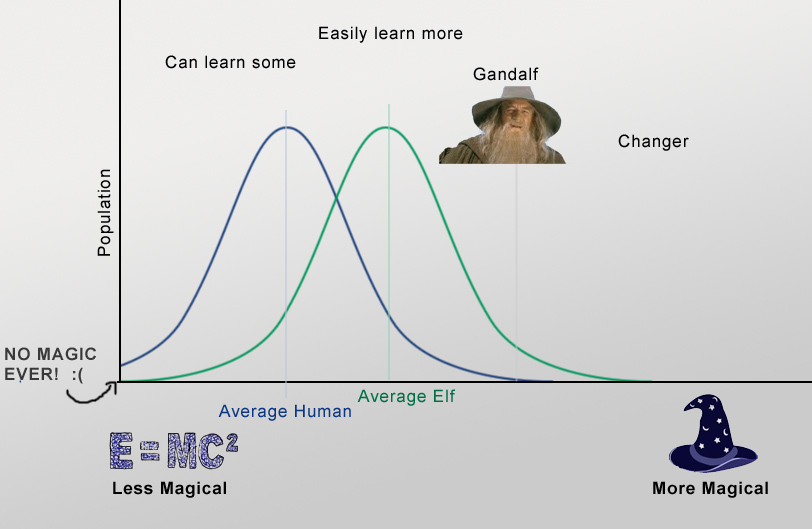
See how some people, maybe 5% of all humans, are actually totally incapable of learning magic, but some even smaller number of elves, like 0.5%, are incapable. That's because we're talking about potential. The average human won't learn magic, but she could.
Here is what happens when humans take magic lessons or, say, grow up on darleone.
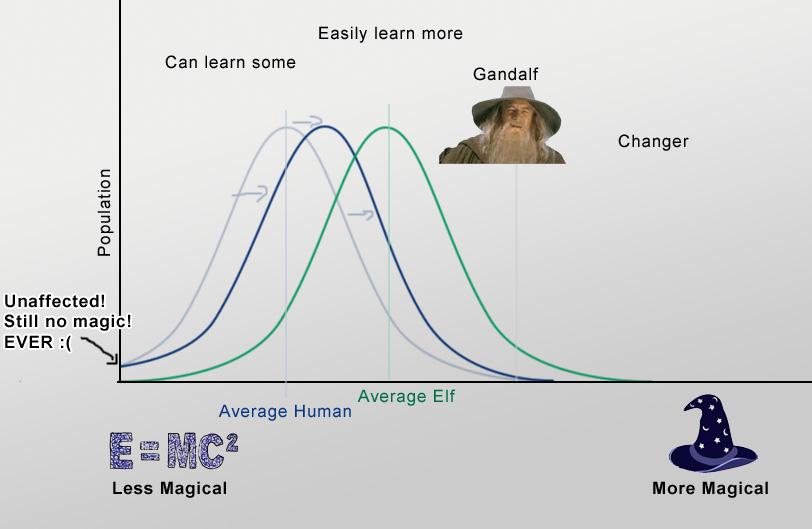
The ones that have zero potential are unaffected. Everyone else's probability of learning magic goes up.
Genetically though there's no difference.
I think there needs to be clarity on the difference between magical ability and magical potential. Pretty much all elves have the potential, but not all have the ability. Many will never encounter the right trigger or the right teacher to unlock the latent potential, but pretty much all of them have it. For that matter, so do humans.
PREPARE TO BE DAZZLED BY GRAPHS
When you're describing people's traits over large populations, you almost always end up with bell curves. This is a bell curve:
Lets say that bell curve describes humans. The total area under the graph represents all people. As you can see, most people fall somewhere in the middle, so we define the middle of that graph as having "average" potential. If you are right in the middle of that graph, you're an ordinary person, which means that you could learn some magic, but you probably won't be very impressive at it, if you learn it at all.
Here is that graph with elves on it. I had to reverse the bottom axis because the first one is confusing and has "better" on the left side when it should be on the right side. I put "worse" on the left so that "zero magic" would be clear.
See how some people, maybe 5% of all humans, are actually totally incapable of learning magic, but some even smaller number of elves, like 0.5%, are incapable. That's because we're talking about potential. The average human won't learn magic, but she could.
I disagree with this because on Darleone one will have her magic nurtured, as opposed to a place like Marn. Ree is the exception in Marn, whereas on Darleone someone with her talents is the norm. As I see it, one of the best ways to learn magic is through exposure - especially exposure when you're young. Children learn quickly and are imaginative, so that's when you want to teach them.I also want to comment that just because an elf came from Darleone (or somewhere else) has little difference on how powerful of a magic user they may be.
Here is what happens when humans take magic lessons or, say, grow up on darleone.
The ones that have zero potential are unaffected. Everyone else's probability of learning magic goes up.
Genetically though there's no difference.
The world is an arena, not a stage. RP is a stage, not an arena.
Re: [RACE] Thoughts on elvish-ness
Oh also, to clarify something. People on the tail ends of all those graphs are probably not going to be normal people. What kind of an elf has absolutely zero potential to ever learn magic no matter what? Probably some kind of vulcan logic nazi. What sort of human can end up being gandalf? Probably a damned weirdo. Magic taps into creativity, and mastering it requires you to master your psyche and treat the universe around you as malleable.
Think Neo in the Matrix (the first one). It's one thing to tell him that he can bend a spoon, and he has the potential to fly around like superman, but even after you tell him a dozen times that reality is plastic, he can't jump off the building and fly away because his psyche hasn't come to terms with it, he hasn't had his epiphany. It's only after he's completely WTFed out of all normal consciousness that he can be superman. Most people will go insane if they go that far. The part of our mind that keeps us sane is also the part of our mind that keeps us from being wizards.
Think Neo in the Matrix (the first one). It's one thing to tell him that he can bend a spoon, and he has the potential to fly around like superman, but even after you tell him a dozen times that reality is plastic, he can't jump off the building and fly away because his psyche hasn't come to terms with it, he hasn't had his epiphany. It's only after he's completely WTFed out of all normal consciousness that he can be superman. Most people will go insane if they go that far. The part of our mind that keeps us sane is also the part of our mind that keeps us from being wizards.
The world is an arena, not a stage. RP is a stage, not an arena.
Re: [RACE] Thoughts on elvish-ness
I liked something Frug mentioned so I'll repeat it in my own words.
The great majority of people have the potential to become decent pianists. Most of them will never become decent pianists, and many of them will never even attempt to do so. Same goes for magic. In elves, most of them have the potential to become very good pianists, not amazing, just better than decent. Half of them might, half of them might not, and of the half that plays the piano, only some of them become very good.
Then there are the rare few elves who are completely tone deaf and think that black keys are the same as white keys. These are the minority elves and probably have something wrong with the way they think. Maybe they don't even understand music at all. These are the equivalents of the completely non-magical elves.
Made more sense to me, for some reason.
Edit: Also I guess singing is a better example because people can sing in lots of different ways and it's a rare person that's completely incapable of it.
The great majority of people have the potential to become decent pianists. Most of them will never become decent pianists, and many of them will never even attempt to do so. Same goes for magic. In elves, most of them have the potential to become very good pianists, not amazing, just better than decent. Half of them might, half of them might not, and of the half that plays the piano, only some of them become very good.
Then there are the rare few elves who are completely tone deaf and think that black keys are the same as white keys. These are the minority elves and probably have something wrong with the way they think. Maybe they don't even understand music at all. These are the equivalents of the completely non-magical elves.
Made more sense to me, for some reason.
Edit: Also I guess singing is a better example because people can sing in lots of different ways and it's a rare person that's completely incapable of it.
(09:20:49) Kahmari: and can't even specificly put what their lore is from then complains when someone knows the lore of their char
(09:21:13) Stella: I too enjo specifcly lore chars.
(09:21:13) Stella: I too enjo specifcly lore chars.
Re: [RACE] Thoughts on elvish-ness
I think we were also debating elves as being inherently magical creatures. In the canon of the setting, if it weren't for magic elves would not exist as a race. Now, though, elves reproduce as humans do. I don't think that means elves are no longer inherently magical.
A story is like a tapestry; it is never finished until the final thread is sewn.
Profile | Thread Tracking
Profile | Thread Tracking
-
Jacel Varti

- Citizen
- Posts: 57
- Joined: Thu Jan 03, 2013 6:17 am
- Name: Jacel Varti
- Race: Elven
Re: [RACE] Thoughts on elvish-ness
I'm still going to have to disagree. Elves are basically humans with pointy ears and longer lives, neither of which is inherently magical. Yes, it is true that elves were originally created with magic. What I fail to see is why using magic to change something leaves the result "magic."
Why Being Nonhuman and Sentient Does Not Make One "Magic"
Say I am a mage, and I want to use magic on a basketball. I used magic to make the ball twice as large as standard. Assuming no other magic acts upon it, it will never do anything paranormal and will always respect the laws of physics. Is the end result "magical" or simply a large basketball? The change was made with magic, but it changed a normal object into another normal object.
It's the same for elves. Say I am a mage, and want to use magic on a human. I used magic to make a human with a longer lifespan and pointed ears. Assuming no other magic acts upon it, it will never do anything paranormal. The change was made with magic, but it was changed from a normal animal into another normal animal.
Conclusion: Nothing about a long-lived pointy-eared human or a large basketball inherently violate the laws of physics. If they do not violate known physical laws, they are not magical.
Why Having a Higher Potential For Magic Does Not Make One "Inherently Magical"
Main Counter Argument: Elves have higher magical potential than humans, meaning they have inherent magic.
Answer:
Having higher potential for magic does not make an elf inherently magical. Because we have established that humans can use magic because of thought patterns which are differnt from the norm, all it means is that elves find it slightly easier to use the thought patters which allow a person to use magic. Thought patterns are based on brain chemistry, not magic. Therefore, elves are not inherently magical.
Also keep in mind that going off of Frug's chart, the vast majority of humans have the potential for magic. If the majority of the species being able to use magic is grounds for calling them "inherently" magic, then humans also fit the criteria.
Conclusion: Having a higher potential for magic means elves have a brain chemistry that makes it easier to think like a wizard, not that they have a spell which affects there entire race.
Why Being Nonhuman and Sentient Does Not Make One "Magic"
Say I am a mage, and I want to use magic on a basketball. I used magic to make the ball twice as large as standard. Assuming no other magic acts upon it, it will never do anything paranormal and will always respect the laws of physics. Is the end result "magical" or simply a large basketball? The change was made with magic, but it changed a normal object into another normal object.
It's the same for elves. Say I am a mage, and want to use magic on a human. I used magic to make a human with a longer lifespan and pointed ears. Assuming no other magic acts upon it, it will never do anything paranormal. The change was made with magic, but it was changed from a normal animal into another normal animal.
Conclusion: Nothing about a long-lived pointy-eared human or a large basketball inherently violate the laws of physics. If they do not violate known physical laws, they are not magical.
Why Having a Higher Potential For Magic Does Not Make One "Inherently Magical"
Main Counter Argument: Elves have higher magical potential than humans, meaning they have inherent magic.
Answer:
Having higher potential for magic does not make an elf inherently magical. Because we have established that humans can use magic because of thought patterns which are differnt from the norm, all it means is that elves find it slightly easier to use the thought patters which allow a person to use magic. Thought patterns are based on brain chemistry, not magic. Therefore, elves are not inherently magical.
Also keep in mind that going off of Frug's chart, the vast majority of humans have the potential for magic. If the majority of the species being able to use magic is grounds for calling them "inherently" magic, then humans also fit the criteria.
Conclusion: Having a higher potential for magic means elves have a brain chemistry that makes it easier to think like a wizard, not that they have a spell which affects there entire race.
Re: [RACE] Thoughts on elvish-ness
I have to disagree as well. I had always understood that potential to do magic was never in question. And, the bell curves support that argument. Everyone has the potential to do magic. But, not everyone is born with the ability to do magic.
It is this innate ability to do magic that makes elves and humans different. Because the ability is innate, then, doesn’t that make elves inherently magical?
I'd always understood that if humans used magic they went crazy. And, this craziness occurred because using magic is unnatural for humans. Yes, there are “humans” who can innately use magic. But, I would argue then, that these are not “real” humans. They are mutations occurring as a result of the bleed through of magic from the Astral realm or as genetic material imprints from the time when there was no seal in place. The seal is imperfect, by the way, or there would be no magic.
I had also understood that to perform magic, one had to tap into the Astral realm. Elves, by their nature, find it easier to reach the Astral realm and to tap into the bleed through from the Astral realm. Humans, must work for that skill and hone it over years. And, like mercury poisoning, it is going to have a negative effect on their health and psyche.
My argument is that elves all have magical abilities, not just the potential. Maybe that magical ability is an uncanny knack of telling when someone’s lying to them (intuition) or maybe they can knit skin and bone back together and make it whole.
I guess it's the nature versus nurture concept? I say magic is in an elf's nature and it requires little effort on the elf’s part to initiate magic. Having said that, I had also interpreted the placement of the Astral Seal as a barrier an elf would have to overcome. So, while making the connection to the Astral is easier, it does take effort to maintain that connection. One last thought – magic defies physics.
It is this innate ability to do magic that makes elves and humans different. Because the ability is innate, then, doesn’t that make elves inherently magical?
I'd always understood that if humans used magic they went crazy. And, this craziness occurred because using magic is unnatural for humans. Yes, there are “humans” who can innately use magic. But, I would argue then, that these are not “real” humans. They are mutations occurring as a result of the bleed through of magic from the Astral realm or as genetic material imprints from the time when there was no seal in place. The seal is imperfect, by the way, or there would be no magic.
I had also understood that to perform magic, one had to tap into the Astral realm. Elves, by their nature, find it easier to reach the Astral realm and to tap into the bleed through from the Astral realm. Humans, must work for that skill and hone it over years. And, like mercury poisoning, it is going to have a negative effect on their health and psyche.
My argument is that elves all have magical abilities, not just the potential. Maybe that magical ability is an uncanny knack of telling when someone’s lying to them (intuition) or maybe they can knit skin and bone back together and make it whole.
I guess it's the nature versus nurture concept? I say magic is in an elf's nature and it requires little effort on the elf’s part to initiate magic. Having said that, I had also interpreted the placement of the Astral Seal as a barrier an elf would have to overcome. So, while making the connection to the Astral is easier, it does take effort to maintain that connection. One last thought – magic defies physics.
A story is like a tapestry; it is never finished until the final thread is sewn.
Profile | Thread Tracking
Profile | Thread Tracking
-
Jacel Varti
- Citizen
- Posts: 57
- Joined: Thu Jan 03, 2013 6:17 am
- Name: Jacel Varti
- Race: Elven
Re: [RACE] Thoughts on elvish-ness
I feel as though I just argued that an innate ability which is a slight advantage in magic use is not "inherently magical." The difference between a wizard and a nonwizard is nothing more than slightly different thought patterns which, thanks to the Astral Plane, allows them to shape the world around them by ignoring reality. Elves simply have a greater capacity to put their belief before physical laws, much like dwarves can dampen magic simply by putting physical laws before evidence of magic.Metarie wrote: It is this innate ability to do magic that makes elves and humans different. Because the ability is innate, then, doesn’t that make elves inherently magical?
The setting information directly states that all magic is shaped by belief. To be better mages than humans, the only thing a species has to do differently is find it easier to believe that they can cast a spell, or believe that they have good luck. Humans find it harder to believe in their ability to cast magic than elves do. Belief is not a magical quality.
Because magic is based on belief, stronger belief gives stronger magic, and belief itself is not inherently magical, elves are not inherently magical. All they have is an innate talent for believing.
I mean no offense by saying this, so please don't misinterpret me here, but I think you are a little bit stuck on this train of thought. I've got several problems with this statement. First of all, we've already got plenty of elves in the setting without magical abilities. My own Jacel is but one of them. Off the top of my head, Navvare's host body had no magic before becoming possessed. In fact, she specifically argues in one of her threads that just because she is an elf does not mean she has magic. We've also got Lurus, a guardsman. Though she's waiting on approval, Annalise is another example. I could find more if I dug around. Thar Shaddin is not a high fantasy book like Eragon, where elves get automatically get cool powers and are better than humans. Elves do not all have magic.Metarie wrote:My argument is that elves all have magical abilities, not just the potential.
Re: [RACE] Thoughts on elvish-ness
I'm afraid I have to agree with Jacel on this one but there does still seem to be some lack of clarity on what it means to be "inherently magical".
Something that's inherently magical will stop happening, or cease to exist, the moment magic is removed from the universe. So a mage's fireball will vanish, a fairy would probably shrivel up and die or vanish... An elf would be fine, except she might notice that some things feel differently or that her abilities no longer work.
A human with magical abilities is not inherently magical, nor is an elf with them. As Jacel says, it comes down to brain chemistry (I'd say it comes down to psychology, in which chemistry and physiology play a role).
Now, I have said in the past that werewolves are inherently magical creatures with an innate ability, but I think that's wrongly worded. A werewolf that isn't doing something magical is just a person or animal who has the potential to magically transform.
A ghost would be inherently magical. It's all non physical and glowy, and would vanish the second magic stopped existing. So if an elf is said to be inherently magical, I have to ask what part of that elf is magical? The cells are perfectly normal, like a human's. It's the mind that's special, but that's where a human's magic comes from too.
Something that's inherently magical will stop happening, or cease to exist, the moment magic is removed from the universe. So a mage's fireball will vanish, a fairy would probably shrivel up and die or vanish... An elf would be fine, except she might notice that some things feel differently or that her abilities no longer work.
A human with magical abilities is not inherently magical, nor is an elf with them. As Jacel says, it comes down to brain chemistry (I'd say it comes down to psychology, in which chemistry and physiology play a role).
Now, I have said in the past that werewolves are inherently magical creatures with an innate ability, but I think that's wrongly worded. A werewolf that isn't doing something magical is just a person or animal who has the potential to magically transform.
A ghost would be inherently magical. It's all non physical and glowy, and would vanish the second magic stopped existing. So if an elf is said to be inherently magical, I have to ask what part of that elf is magical? The cells are perfectly normal, like a human's. It's the mind that's special, but that's where a human's magic comes from too.
Some elves and some humans are born with it, and those babies are probably a whole load of trouble. Imagine the kind of damage an infant could cause with unfettered manipulation over the physical world! In the vast majority of cases, neither elves nor humans are born with any talents. Only potential equal to their place on the bell curve.Ree wrote:not everyone is born with the ability to do magic.
Most humans have the innate ability to learn magic as well. Else where does it come from?Ree wrote:It is this innate ability to do magic that makes elves and humans different. Because the ability is innate, then, doesn’t that make elves inherently magical?
The world is an arena, not a stage. RP is a stage, not an arena.
Re: [RACE] Thoughts on elvish-ness
So on the piano/singing thing again, just a couple thoughts.
Let's say a potential Elvis Presley is born. He has a natural talent for singing. Unfortunately, potential Elvis doesn't listen to much music, and grows up in a city where it's abolished and considered the work of the devil. Ultimately he ends up hating music in general and never sings much at all. Without training, he might even be really bad at it if he did try.
This is the same as magic. If you grow up in Marn, and you're an elf, you have above average potential to learn magic when compared to a human. You might even have well above average potential. But if you're brought up in a place where magic is hated and feared 90% of the time, then you're probably not going to go anywhere near it. Now, there are plenty of elves and even the occasional human that one day discovers they can just -do- something. These people have something of an instinct for magic. One day, a little elf child wakes up and accidentally blows up the kitchen because of some trigger. That's a kind of instinct. But many elves may not have that instinct at all. And, I don't think most of them have it as a newborn. They usually have some kind of trigger.
This obviously goes the other way too. If you're an elf brought up on Darleone, it's pretty unlikely that you'll grow up to have no magical ability at all, and even less likely that you have no potential at all. But, these elves still exist. Potential does not guarantee that they'll have any abilities whatsoever, but if you foster potential, abilities usually happen. On Darleone, they almost always do.
Let's say a potential Elvis Presley is born. He has a natural talent for singing. Unfortunately, potential Elvis doesn't listen to much music, and grows up in a city where it's abolished and considered the work of the devil. Ultimately he ends up hating music in general and never sings much at all. Without training, he might even be really bad at it if he did try.
This is the same as magic. If you grow up in Marn, and you're an elf, you have above average potential to learn magic when compared to a human. You might even have well above average potential. But if you're brought up in a place where magic is hated and feared 90% of the time, then you're probably not going to go anywhere near it. Now, there are plenty of elves and even the occasional human that one day discovers they can just -do- something. These people have something of an instinct for magic. One day, a little elf child wakes up and accidentally blows up the kitchen because of some trigger. That's a kind of instinct. But many elves may not have that instinct at all. And, I don't think most of them have it as a newborn. They usually have some kind of trigger.
This obviously goes the other way too. If you're an elf brought up on Darleone, it's pretty unlikely that you'll grow up to have no magical ability at all, and even less likely that you have no potential at all. But, these elves still exist. Potential does not guarantee that they'll have any abilities whatsoever, but if you foster potential, abilities usually happen. On Darleone, they almost always do.
(09:20:49) Kahmari: and can't even specificly put what their lore is from then complains when someone knows the lore of their char
(09:21:13) Stella: I too enjo specifcly lore chars.
(09:21:13) Stella: I too enjo specifcly lore chars.